Seattle short-term rental laws (2026)
Seattle allows short-term rentals in any legal dwelling unit, with a City of Seattle operator license for stays of fewer than 30 consecutive nights. The limit is on how many: most hosts may license two units, their primary residence and one more. Renters cannot get a license unless their downtown unit was already running before September 30, 2017, and a secondary unit has to be registered with the city's rental inspection program first. Washington state law adds $1 million in primary liability insurance unless every stay is booked through a platform that carries it. Operating without the license draws $500 for a first violation and $1,000 after that.[1]
Every rule below links to the official source it comes from, verified September 14, 2026.
Is Airbnb legal in Seattle?
Legal, with a city license
In legal dwelling units, with a city operator license. Most hosts can license two units, their home and one more.
9 official sources · verified September 14, 2026
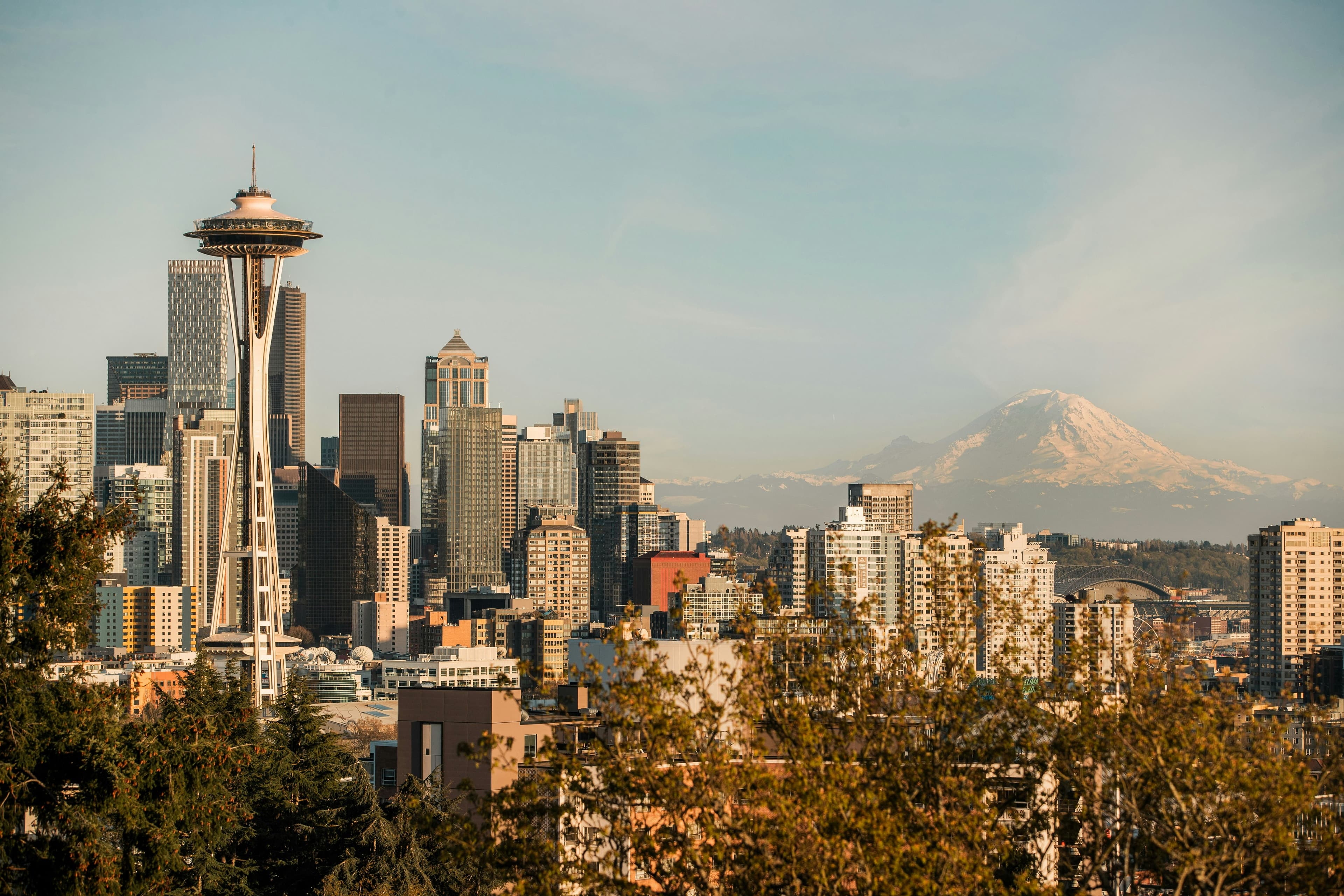
Photo: Toan Chu on Unsplash
- PermitRequired · $75 per unit, renewed yearly
- Primary residenceVaries
- Number on listingRequired
- Night capNone published
Every Seattle rule, sorted by what it asks
Filter by topic. Each line carries the number of its official source, listed at the bottom of the page.
You must
- Hold an operator license for stays under 30 nights[1]
- Get a Seattle business license tax certificate before applying[1]
- Register any secondary unit with the rental registration program[1][4]
- Get a separate license for each accessory dwelling unit[1]
- Show your license number on every listing as STR-OPLI-##-######[1]
- Renew the license every year in the Seattle Services Portal[1]
- Identify your primary residence at each renewal[4]
- Make one unit your primary residence if you run two[1]
- Rent only a legal dwelling unit[5]
- Keep a contact available to answer guests during every stay[7][1]
- Post the address, emergency numbers, fire exit plan, max occupancy and contact[7][1]
- Install carbon monoxide alarms under Washington's rules[7]
- Meet current building and safety codes[1]
- Meet basic habitability requirements in your primary residence[1]
- Carry $1 million primary liability insurance, or book only via platforms that do[6]
- Register and report your rental income, even on Airbnb[9]
You must not
- Apply as a renter, except downtown units running before September 30, 2017[1]
- Run more than 2 units, except downtown units running before September 30, 2017[1][5]
- Rent an RV, tent, garage, boat or other space that is not a dwelling unit[2]
- Rent a live-work unit, houseboat or waterfront residence[1]
- Run a business that breaks a zoning ordinance[5]
- Give false information on an application or renewal[5]
Not required
What a new permit costs
Operator license fee per unit, renewed every year
$75new license
- Operator license$75
The city does not publish the cost of the business license tax certificate you also need.[1]
How to apply in Seattle
Official name: Short-term rental operator license
- 1
Get a Seattle business license tax certificate on filelocal-wa.gov and wait 48 hours before the next step.[1]
- 2
If a unit is not your primary residence, register it with the Rental Registration and Inspection Ordinance program.[1]
- 3
In the Seattle Services Portal, choose Licenses, then Short Term Rental, and start the operator license application.[3]
- 4
Enter your business license number and add your primary and secondary units.[3]
- 5
Pay the $75 fee per unit.[1]
Four jurisdictions, same questions
The Seattle column comes from the official sources on this page. The other columns show the headline rule from each WonderGuest page. Open a page for the full detail.
| Question | Seattle | Florida | Austin | San Bernardino County |
|---|---|---|---|---|
| Permit | Required$75 per unit, renewed yearly | RequiredState license, $170 a year | Required$836.30 new, up to 2 years | Required$1,144 new, 1 year |
| Primary residence | Varies | Not required | Not required | Not required |
| Night cap | None published | None published by the state | None published | None published |
| Number on listing | Required | Not required | Required | Required |
| Where allowed | Your home plus 1 other unit | No local bans after June 1, 2011 | Every zoning district | Mountain and Desert Regions only |
| Occupancy tax | Lodging taxes, Airbnb collects | 6% state tax, Airbnb collects | 11% city tax, platforms collect | 7% county TOT, Airbnb collects |
| Fine without permit | $500 first violation, then $1,000 | Second-degree misdemeanor | Up to $500 per offense, per day | $1,000 per violation per day |
| Florida rules | Austin rules | San Bernardino County rules |
Coming up
What's changing
No change with an effective date appears in the official sources on this page as of September 14, 2026.
FAQ
Seattle short-term rental questions
How do I apply for a short-term rental operator license in Seattle?
How do I renew my Seattle short-term rental operator license?
Can I rent out my backyard cottage in Seattle?
Does Seattle have its own short-term rental tax?
Sources
- Short-term rentals, City of Seattle Finance and Administrative Services, read on September 14, 2026
- Short-term rentals, land use code, Seattle Department of Construction and Inspections, read on September 14, 2026
- How do I apply for a short-term rental operator's license?, City of Seattle Services Portal help center, read on September 14, 2026
- How do I renew my short-term rental operator license?, City of Seattle Services Portal help center, read on September 14, 2026
- Short-term rental operator license application (September 2023), City of Seattle Finance and Administrative Services, read on September 14, 2026
- RCW chapter 64.37, short-term rentals, Washington State Legislature, read on September 14, 2026
- RCW 64.37.030, consumer safety, Washington State Legislature, read on September 14, 2026
- Lodging taxes, Washington State Department of Revenue, read on September 14, 2026
- Airbnb to collect and send taxes on behalf of hosts, Washington State Department of Revenue, read on September 14, 2026
This page is not legal advice. It summarizes the official sources listed on this page as they read on September 14, 2026. Rules can change after that date, so check with the issuing office before you apply or publish a listing.
Before you list
Free tools for new hosts
Short-term rental agreement generator
Parties, dates, rent, deposit checked against your state's cap, and the house rules clauses you enforce. A signed-ready PDF for direct and Vrbo bookings.
Airbnb house rules
Generate a complete PDF house rules document for your property: rules, schedule, amenities, emergency contacts.
Rental arbitrage calculator
Rent, deposit, furnishing, nightly rate and occupancy. You get monthly cash flow, the occupancy you break even at, and how long the setup takes to pay back.
Check-in instructions
The message a guest reads before getting in: access, keys, WiFi, parking, contact. English or bilingual output.