San Antonio short-term rental laws (2026)
Every short-term rental in San Antonio needs a city permit, and the permit is available in every zoning district except C-3, L, I-1 and I-2. It comes in two types: Type 1 when the owner or operator lives on the property, Type 2 when nobody does. Type 1 has no density limit, while Type 2 rentals are held to one-eighth of the single-family to fourplex units on a block face, rounded down. Permits run three years and are issued within five business days of a complete application. A violation is a Class C misdemeanor fined $100 to $500 for each day it continues.[1]
Every rule below links to the official source it comes from, verified September 14, 2026.
Is Airbnb legal in San Antonio?
Legal, with a city permit
Type 1 if the owner or operator lives on site, Type 2 if not. Type 2 rentals are capped at 12.5% of a block face.
8 official sources · verified September 14, 2026
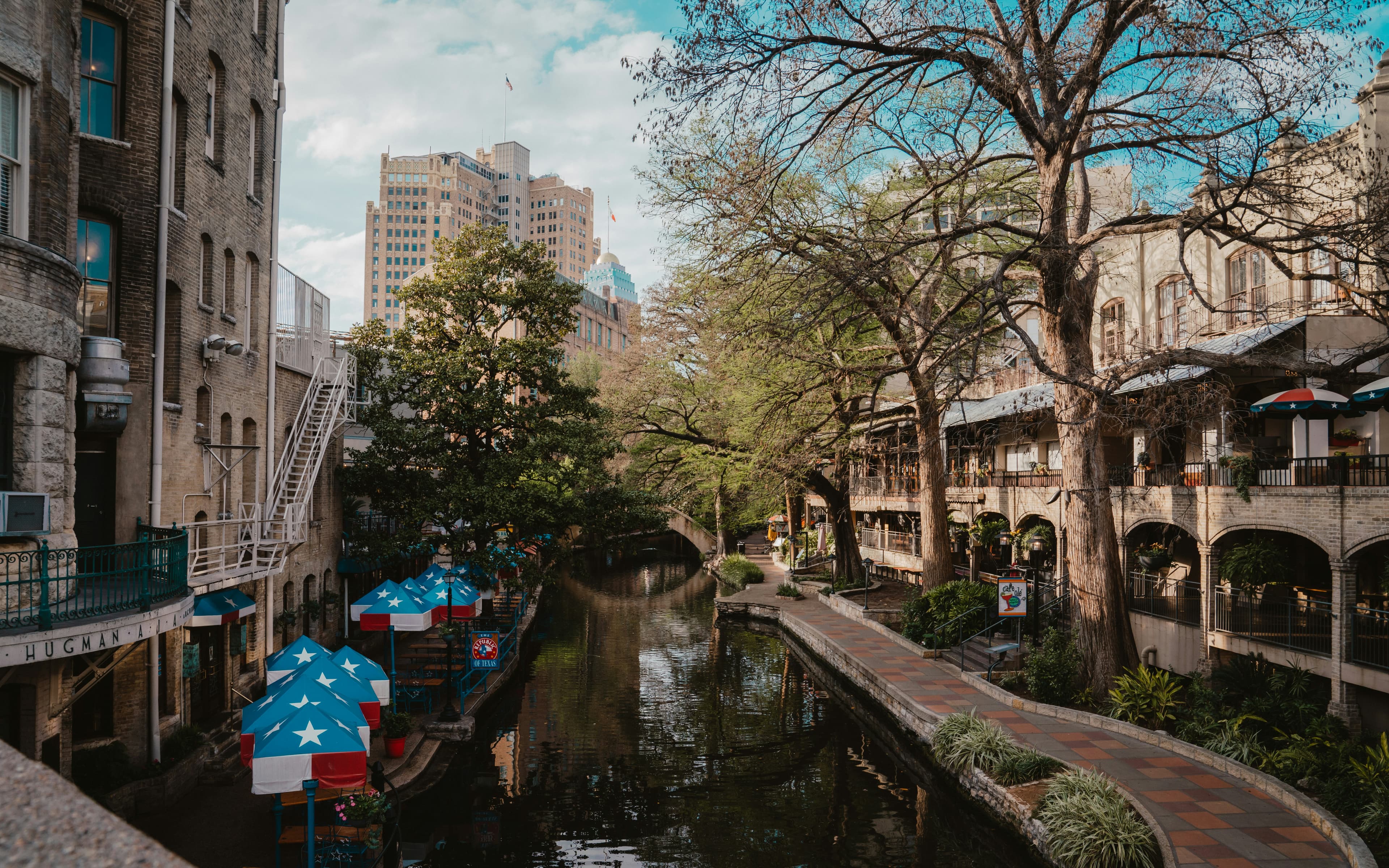
Photo: Eric Francis on Unsplash
- PermitRequired · $300 or $450, every 3 years
- Primary residenceVaries
- Number on listingRequired
- Night capNone published
Every San Antonio rule, sorted by what it asks
Filter by topic. Each line carries the number of its official source, listed at the bottom of the page.
You must
- Hold a Type 1 permit if an owner or operator lives there, Type 2 if not[1][4]
- Renew every 3 years, before expiration, or it counts as a new application[2][1]
- Put the permit number in the description of every ad and listing[1]
- Get a Board of Adjustment special exception to exceed the Type 2 limit[2]
- Type 1: prove your legal residence on site, such as by homestead exemption[1]
- Provide at least one off-street parking space per unit[4]
- Be generally present when renting part of your home under Type 1[1]
- Name an individual, not a business, as operator, with a 24-hour phone[4]
- Try to reach guests within 1 hour when the city calls about a citation[1]
- Keep quiet hours, 10 p.m. to 6 a.m. Sunday to Thursday, 11 p.m. on weekends[1]
- Mount a fire extinguisher on each floor, within 75 feet of every part[1]
- Install smoke and carbon monoxide detectors[1]
- Post an evacuation plan and give each sleeping area an emergency escape opening[1]
- Carry insurance sufficient for guests' personal injury liability[1]
- File monthly hotel tax reports and pay Bexar County hotel tax[7]
- Pay late hotel tax within 90 days of a delinquency notice[1]
You must not
- Transfer the permit[2]
- Count more than one extra unit as Type 1 on an owner-occupied parcel[1]
- Reapply for the same property within 12 months of a revocation[1]
- Rent part of a unit under a Type 2 permit[1]
- Exceed the Type 2 cap of one-eighth of a block face, rounded down[5][6]
- Exceed 1 Type 2 rental in a 5 to 7 unit building, or one-eighth in 8 or more[5]
- Run a Type 2 rental in an accessory dwelling unit[6]
- Operate in the C-3, L, I-1 or I-2 zoning districts[2]
- Host weddings, events or meetings in a residential district[5]
- Exceed the 63-decibel noise cap[1]
What a new permit costs
Fee per permit for a new application or a renewal, valid three years
$300Type 1, every three years
- Type 1 permit$300
- Type 2 permit$450
- Type 2 limit exception, homestead$400
- Type 2 limit exception, no homestead$600
Applications by mail or in person add a $10 processing fee. Fees are non-refundable.[4]
How to apply in San Antonio
Official name: Short Term Rental (STR) permit
- 1
Check that your zoning district allows short-term rentals and, for Type 2, that the block face is under its limit.[2]
- 2
Sketch the floor plan with sleeping areas, maximum guests, evacuation routes and fire extinguishers, plus the off-street parking.[4]
- 3
If you are not the owner, get a signed and notarized authorization from the property owner.[4]
- 4
Apply through the BuildSA portal and pay the fee. Permits are issued within five business days of a complete application.[2]
- 5
Set up hotel occupancy tax reporting, due every month even when the amount is zero.[3]
- 6
Add the permit number to every listing and post the occupancy limit, 24-hour contact and evacuation plan inside the unit.[1]
Four jurisdictions, same questions
The San Antonio column comes from the official sources on this page. The other columns show the headline rule from each WonderGuest page. Open a page for the full detail.
| Question | San Antonio | Austin | Houston | Florida |
|---|---|---|---|---|
| Permit | Required$300 or $450, every 3 years | Required$836.30 new, up to 2 years | Required$275 a year plus administrative fee | RequiredState license, $170 a year |
| Primary residence | Varies | Not required | Not required | Not required |
| Night cap | None published | None published | None published | None published by the state |
| Number on listing | Required | Required | Required | Not required |
| Where allowed | Not in C-3, L, I-1 or I-2 districts | Every zoning district | Inside city limits, within HOA rules | No local bans after June 1, 2011 |
| Occupancy tax | 6% state hotel tax | 11% city tax, platforms collect | 7% city hotel tax, paid quarterly | 6% state tax, Airbnb collects |
| Fine without permit | $100 to $500 per violation per day | Up to $500 per offense, per day | $100 to $500 per violation per day | Second-degree misdemeanor |
| Austin rules | Houston rules | Florida rules |
Coming up
What's changing
No change with an effective date appears in the official sources on this page as of September 14, 2026.
FAQ
San Antonio short-term rental questions
Does San Antonio allow short-term rentals?
How do I apply for a short-term rental permit in San Antonio?
How many Type 2 short-term rentals are allowed on my block?
If Airbnb collects hotel tax, do I still file reports in San Antonio?
Sources
- Ordinance 2024-06-13-0433 (City Code chapter 16, article XXII), City of San Antonio, read on September 14, 2026
- Short-term rental permits, City of San Antonio Development Services Department, read on September 14, 2026
- Short-term rentals, City of San Antonio Development Services Department, read on September 14, 2026
- Application for short-term rental permit (May 22, 2026), City of San Antonio Development Services Department, read on September 14, 2026
- Short-term rental ordinance updates (February 21, 2024), City of San Antonio Development Services Department, read on September 14, 2026
- Current short-term rental ordinance (presentation), City of San Antonio Development Services Department, read on September 14, 2026
- Hotel occupancy tax: short-term rentals, City of San Antonio Finance Department, read on September 14, 2026
- Hotel occupancy tax FAQs, Texas Comptroller of Public Accounts, read on September 14, 2026
This page is not legal advice. It summarizes the official sources listed on this page as they read on September 14, 2026. Rules can change after that date, so check with the issuing office before you apply or publish a listing.
Before you list
Free tools for new hosts
Short-term rental agreement generator
Parties, dates, rent, deposit checked against your state's cap, and the house rules clauses you enforce. A signed-ready PDF for direct and Vrbo bookings.
Airbnb house rules
Generate a complete PDF house rules document for your property: rules, schedule, amenities, emergency contacts.
Rental arbitrage calculator
Rent, deposit, furnishing, nightly rate and occupancy. You get monthly cash flow, the occupancy you break even at, and how long the setup takes to pay back.
Check-in instructions
The message a guest reads before getting in: access, keys, WiFi, parking, contact. English or bilingual output.