The Airbnb welcome binder, built for $27.94 at Staples
A twelve-page binder costs $27.94 to build at Staples, and the restaurant pages stay out of the rings because guests carry them out the door.


Written by Alexandre Pidault
Founder of WonderGuest
A laminated page becomes trash the day your Wi-Fi code changes. The same page in a clear sleeve is replaced for $0.82, which is why Robin129, a Level 10 host on Airbnb's Community Center, slides two sheets back to back into every protector. Twelve pages then ride in six sleeves, and a wrong one comes out on its own.
What a welcome binder is, and what the object has to survive
A welcome binder is a three-ring binder that sits in the property. Inside it are printed pages, usually slid into clear sleeves and sorted behind tabbed dividers a guest can flip to without reading the rest. That is the whole format, and hosts name it plainly: "I have this. I call it a Welcome Binder. It is a three ring binder that sits on the kitchen table," wrote Emilia42, a Level 10 host, on December 15, 2019.
The words around it slide. Pin them down first. The welcome book is the document: the pages themselves, whatever they are printed on. Airbnb's house manual is the version that lives inside the platform rather than on paper. The binder is the physical container, and it is the only one of the three you can spill coffee on. Deliver the same printable pages by link and they become a digital guidebook.
Joan2709, a Top Contributor on Airbnb's Community Center, put it in one line on April 1, 2025: "Most hosts also create a paper version in a 3-ring binder (put pages in sheet protectors) inside the listing." Sleeves first. A binder assembled page by page can be repaired page by page, and a bound book cannot.
Binder, bound book or link: what each one actually does
Here is what each one does at US list prices on September 21, 2026.
| Three-ring binder | Saddle-stitched printed book | Pages on a link | |
|---|---|---|---|
| Build one, 12 pages | $27.94 at Staples list prices | $10.99 at Vistaprint in letter size, plus shipping | Touch Stay publishes about $10 per month per property on its own blog |
| Correct one wrong line | $0.82 for a color reprint, swap the sleeve | Reorder the whole run | Edit and save |
| Sizes you can get | Letter, legal or tabloid, nothing else | Ten sizes at Vistaprint, including 5.5 by 8.5 inches | Whatever phone the guest brought |
| Who can read it at 11 PM | Whoever is in the room where it sits | Same | Anyone with the link |
| What survives a season | Sleeves protect the paper, the paper still tears | Same paper, no sleeves | No physical object |
| What you can measure | Nothing | Nothing | Vendor dashboards |
One line in that table needs its source. The $10 per month comes from Touch Stay's own blog, where it sits next to its estimate of $10 to $20 per printed copy.
The page order in a printable welcome binder, and the page that leaves it
Ask ten hosts what goes in a binder and you get ten section lists. Ask what order they sit in and one sequence keeps coming back on Airbnb's Community Center.
Sally456 posted hers on May 14, 2024: welcome note and phone numbers, Wi-Fi, emergency numbers and the nearest hospital, a diagram of the apartment with exits, appliance instructions, then restaurants and transport. Every page in a sleeve. That order holds up, with one adjustment and one removal.
The adjustment is Wi-Fi. Colleen253, a Level 10 host, puts the password at the bottom of the first page on purpose: "It's the last item on the page, so guests have to read the whole page to find it." Copy that placement. Put the password at the bottom of a single page that also carries your house rules and the check-in basics, so the rest of the page gets read on the way down. On paper the placement matters more than it does on a screen, because a guest with a link can search for the word Wi-Fi and a guest holding a sleeve has to turn tabs. One sleeve then does the work of three.
Some hosts add a second place instead of a lever. Emilia42, also Level 10, keeps the password off Airbnb itself: "I don't put my wifi username and password anywhere on the Airbnb website or app, the placement is horrible." Hers lives in a framed card on the kitchen table, and on January 10, 2020 she reported that "Only two guests out of over 450 didn't see it and had to ask." Beth80 frames it in every bedroom as well. Two places means two things to update when the router changes, so pick the one you will actually remember, and a Wi-Fi QR code in the frame spares guests from typing anything.
The removal is the restaurant section. Susan151 clips hers by neighborhood: "Each neighborhood is clipped together so that guests can throw them into a back pack when they head out in the AM. This has been very popular." Restaurant pages are the ones Susan151's guests carry out the door. Keep them out of the rings.
So the working order runs: welcome note and phone numbers, the single Wi-Fi and rules page, emergencies and the nearest hospital, the floor plan and exits, appliances, check-out and trash, then the neighborhood last and loose. Appliances will be your longest section. Write it for the guest standing in front of a dishwasher they have never seen.
Sheet protectors, not lamination. A 100-pack of Avery letter-size sleeves runs $16.89 at Staples, which Staples itself prices at $0.17 per sleeve. In-store lamination starts at $1.99 per letter-size pouch in 5 mil. Twelve times the price, and that is the smaller problem. Lamination is permanent: the day your code changes, a laminated page goes in the trash, and a sleeved page gets a new sheet slid into it.
Robin129, Level 10, posted the refinement the same day: "I use sheet protectors, print on single pages but place two back-to-back in them. This makes it easy to update pages without having to start over." Load them that way and a wrong page comes out on its own, without disturbing the eleven around it.
Tabs are not optional either. Joan2709 again, on May 21, 2024: hosts "add tabs for each section (otherwise the guests find it too overwhelming and don't use it)".
Build the binder in five steps
Start from a file you can reopen.
TheGooDocs publishes a free 10-page printable welcome book template, no account required, attribution required. Paid files start at $1.25 on the marketplaces and most sit under $10, usually as a Canva link delivered inside a PDF. Twelve pages is a working target: six sleeves at two sheets each, $9.84 in color at Staples, short enough that a guest flips through it. Cap the page count against your own repeat questions before you print anything, and keep the source file somewhere you can find again in March.
Print single-sided, in order.
Staples publishes $0.34 per page in black and white and $0.82 in color, in exactly three paper sizes: 8.5 by 11, 8.5 by 14 and 11 by 17 inches. Color for the floor plan and the appliance photos. Black and white for the rest. Carry the stack home in order, because collating it on the kitchen table is where an hour disappears.
Assemble with sleeves and tabs.
A Staples 1-inch D-ring view binder is $11.79 and holds up to 220 sheets, roughly eighteen times what you need. A five-tab set of insertable dividers is $5.29. Load two sheets per sleeve, back to back, per Robin129.
Laminate only what leaves the binder.
The recycling chart on the bin and the grill card on the patio. The note taped inside a closet. In-store lamination is $1.99 per letter page at Staples. The cheapest thermal laminator Staples lists is $33.99 and 3 mil letter pouches are $20.49 per hundred, about $0.20 each, so the machine pays for itself at 19 pages. Under nineteen, use the store. Staples' lamination table has only letter, letter-or-ledger and a per-square-foot large-format line, so no price is published for anything smaller than letter.
Put it where the guest already stands.
Emilia42's binder sits on the kitchen table. Joan2709's sits next to the welcome snack basket. Romina242 puts hers on the coffee table with the takeout menus and tourist pamphlets, which is honest about what a binder is: a pile of paper with a spine.
What a binder costs, including the parts nobody prices
At Staples list prices on September 21, 2026:
| Line | Cost |
|---|---|
| Template, if you buy one | $1.25 to $18.01 |
| 12 color pages at $0.82 | $9.84 |
| 1-inch D-ring binder | $11.79 |
| 6 sheet protectors at $0.17, two sheets each | $1.02 |
| Five-tab divider set | $5.29 |
| Total, one property, template aside | $27.94 |
Year two is cheap if nothing breaks. Two pages change, the Wi-Fi and one appliance, and you are out $1.64 plus a trip to the store. How often the binder itself has to be rebuilt is not published by anyone in this field, so read the $27.94 as a first-year figure and nothing more.
A bound copy prices differently. Vistaprint prints saddle-stitched runs from a quantity of one, and the same twelve pages cost $10.99 in letter size or $7.99 at 5.5 by 8.5 inches. Shipping is quoted per configuration: the letter version showed $5.99 standard to ZIP 02451 and the half-letter version $4.99, with economy free above $100.00. Staples prints saddle-stitched runs too, from $1.70 per 8 pages in black and white and $4.04 in color, though it publishes neither its sizes nor a minimum quantity. Cheaper than the binder and better looking. Also uncorrectable.
Now the gaps.
FedEx Office publishes no per-page rate at all. Its own self-service page says it twice: "Prices vary by store. Contact your local store for details." That page also rules out the obvious workaround, since customers cannot bring their own paper to the machines. Staples is barely better on this point: the $0.34 and $0.82 are "From" prices, and nothing on its document printing page or its in-store printing page splits counter service from the copier.
One line of that table comes from outside the print shop: the file itself. Paid templates ran from $1.25 to $18.01 on the marketplace results page of September 21, 2026, and what arrives is usually a PDF holding a link to a Canva file rather than the file. Read the license before you print. Several of those listings forbid commercial use in writing, and a binder is a physical copy sitting in a room you rent out.
The rest stays true: nobody publishes the complete cost. The only dollar range in the field is Touch Stay's $10 to $20 per copy, on its own blog, with no printer and no quote behind it.
Five things that go wrong with a binder in production
Lamination does not save the pages. Naureen-and-Shehryar0 wrote on January 16, 2025 that across their properties, "the pages (despite being laminated) would just deteriorate over time - guests would spill stuff on them". That post goes on to promote a paid product, so read it accordingly. The observation still matches the sleeve math.
Nothing about a binder tells you it was opened. A sleeve looks the same on checkout day whether the guest read page four or used the cover as a coaster, and there is no version of paper that reports back. The vendors selling the alternative do not close that gap, they only assert it. GleamSync credits a 23% drop in guest messages to "Touchstay's 2025 host survey," and Touch Stay publishes no such figure, not on its homepage, not on any of the six articles it ranks with, not on the page for its own guest report. What it does publish is 92% of customers saying they save time, with no date, no sample size and no method attached to it. Different measurement. Your binder gives you neither number, and it cannot, because the only signal a binder emits is wear on the tabs.
It exists in one room at a time. The guest standing at the grill does not have it, and neither does the one already driving to the airport and wondering which bin the recycling goes in.
The print shop decides your format. Staples offers letter, legal and tabloid, and FedEx Office offers the same three. Half-letter turns up in Vistaprint's saddle-stitch configurator and in neither chain's document-printing lineup, so a design built at 5.5 by 8.5 inches will not print as a document at Staples or FedEx Office.
It wears out, and pages walk off. Cor3 reported on December 15, 2019: "I have to replace it once a year, as it will be torn after 1 season." Mind the scale. Cor3 runs a Portuguese property whose legally required manual runs past 350 pages, so the wear is not comparable. Some hosts keep theirs without affection. Lyndsey45, December 5, 2025: "My welcome book is already on Google docs and I just print it and put it in a binder (which I hate)."
The threshold where paper stops paying
One binder for one property is cheap and hard to beat. Roughly $29 up front and maybe $2 a year in reprints is cheaper than any per-month plan whose price is actually published. Most of this field does not publish one. Touch Stay's pricing page is a calculator with no tiers and no figures, and its $10 per month per property appears only on its own blog.
Two numbers move the decision. The first is your property count, because every copy is a separate object in a separate building. Three properties means three binders and three trips to the print shop. One of them will still have the old trash day on it. The second is your change rate. Count the lines that went stale in the last twelve months: the Wi-Fi password, the cleaner's number, the trash schedule, a new coffee maker. Past four changes a year on a single property, or past two properties at any change rate, the dollars still favor paper and nothing else does.
Lodgify recommends updating a printed welcome book at least twice a year, and no one has measured what hosts actually do.
One thing to be straight about: nobody has published a read rate for a link either. What is measurable is the update. A wrong line on the link is fixed once and is correct for the guest who checked in yesterday. A wrong line in a binder is correct only after someone drives to the store.
Four steps to put the same pages on a link
Create the account.
Sign up at app.wonderguest.app and add the property. The free plan is enough to see the whole thing before you commit.
Move the pages you already wrote.
Your sections map one to one: welcome note, Wi-Fi and house rules, emergencies, floor plan, appliances, check-in and check-out, neighborhood. If the pages live in Canva, the text pastes straight across.
Share it as a link and a QR code.
One QR code on the fridge replaces the binder's only real advantage, which is being visible in the kitchen. Guests who arrive at 1 AM get the door code on their phone instead of hunting for a binder in the dark.
Keep the binder if it earns its keep.
Print the neighborhood pages, clip them by area the way Susan151 does, and leave them on the counter. Those are the pages that get carried out the door, and they change less often than anything else in the rings. Everything that changes lives on the link.
A cleaning checklist generator covers the pages your cleaner needs rather than your guests, and the tool hub holds the rest.
Questions hosts ask about welcome binders
What should I put in an Airbnb welcome binder?
Welcome note and phone numbers, a single page with Wi-Fi and house rules, emergency numbers and the nearest hospital, a floor plan with exits, appliance instructions, check-out and trash, then neighborhood recommendations. That order comes from Sally456's list on the Airbnb Community Center, with the Wi-Fi moved to the bottom of page one and the restaurant pages pulled out so guests can carry them. Your appliance section will be the longest. The essentials checklist covers what belongs in the property rather than the binder.
Should I laminate the pages?
Only the ones that leave the binder. Sheet protectors cost $0.17 each at Staples against $1.99 per page for in-store lamination, and a laminated page cannot be updated. Laminate what lives outside the rings and gets handled wet.
How many pages should a welcome binder be?
Emilia42 keeps her house information to about three pages, plus separate restaurant pages and sample menus. Lodgify suggests 10 to 20 pages. Twelve is a reasonable working target: it fits six sleeves at two sheets each, costs $9.84 to print in color at Staples, and stays short enough that a guest will flip through it.
Can I build a welcome binder from a free printable template?
Yes. TheGooDocs publishes a free 10-page welcome book template in Google Docs and Word format, no account required, attribution required. Canva gives you more control over layout and makes reprints faster, which matters more than the starting file by your fourth revision.
How much does it cost to print an Airbnb welcome binder?
$27.94 for one property at Staples list prices on September 21, 2026: $9.84 of color printing, $11.79 for the binder, $1.02 of sleeves, $5.29 of tab dividers. FedEx Office publishes no per-page price, so there is no comparison figure.
How often should I update the binder?
Whenever a line goes wrong. No schedule survives a router swap, and no publisher reports what hosts actually do. The practical answer is Robin129's: print single-sided, two sheets back to back in each sleeve, so fixing one page costs $0.82 instead of a full reprint.
Is a binder still useful once I have a digital guidebook?
For the neighborhood pages, yes. They are the pages guests carry, and they change less often than anything else in the binder. Keep codes and dates on the link, where correcting them costs nothing. Our guide to the Airbnb guidebook feature walks through what it covers and what it leaves out.
Alexandre Pidault
Founder of WonderGuest
I built the guest-experience tools for the FlexyLoc concierge service (digital guidebooks, interactive guides and videos) before launching WonderGuest. I write here about automating the guest experience in short-term rentals.
More about the author →A WiFi QR code is great.
A complete digital guidebook is even better.
Reduce guest messages and boost your 5-star reviews on Airbnb by centralizing all your property information in one place.
In 2 minutes with your Airbnb listing
Similar articles

Airbnb welcome book and house manual: free templates to print
The free Airbnb welcome book template, plus a house manual PDF for the Airbnb field. What each one holds, and the US sections guests message about.
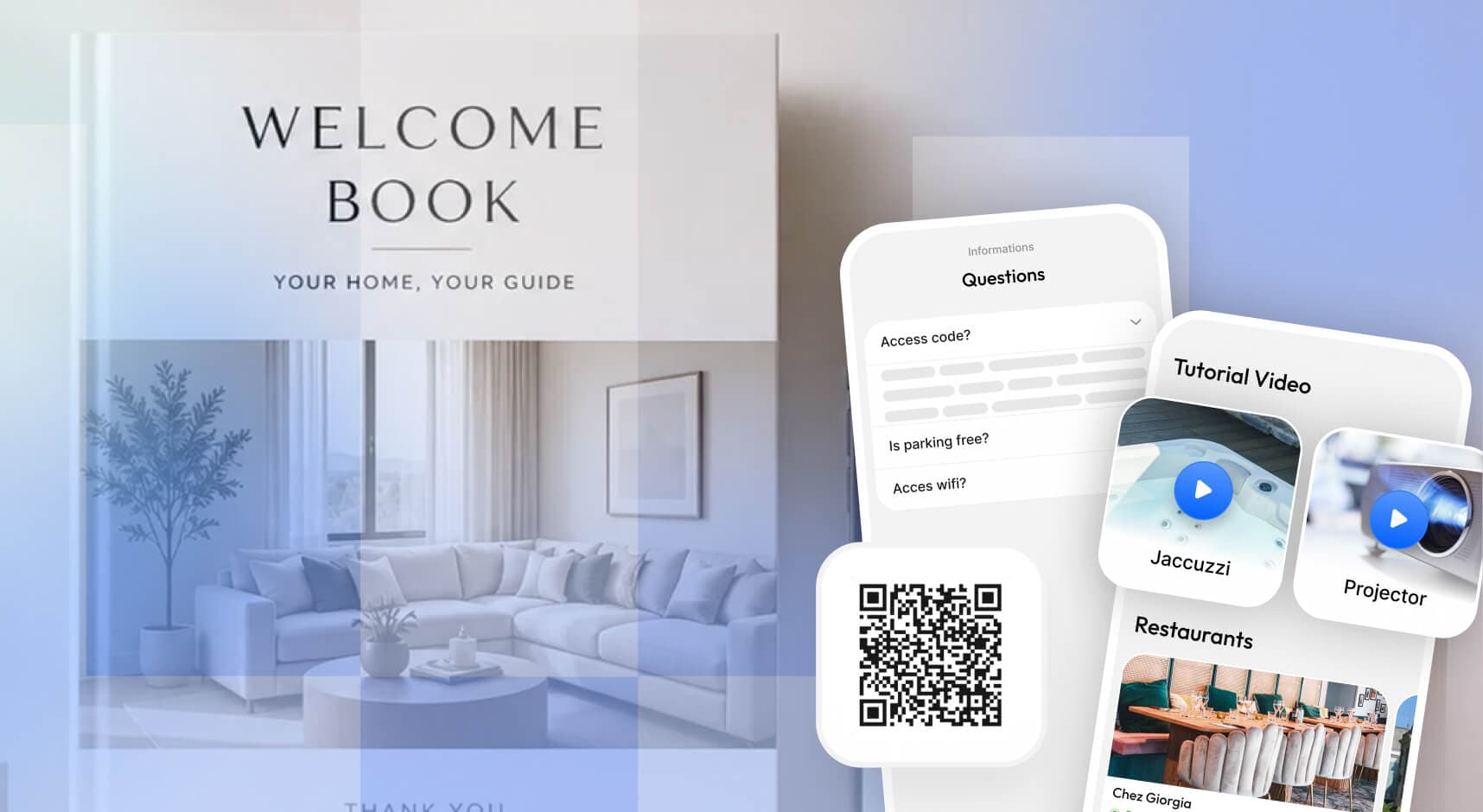
Airbnb welcome book templates in Canva: what to put inside
One to two hours in Canva, no design skill needed. Which templates to open, the five settings that decide how it turns out, and the point where a digital guidebook costs less than the PDF.
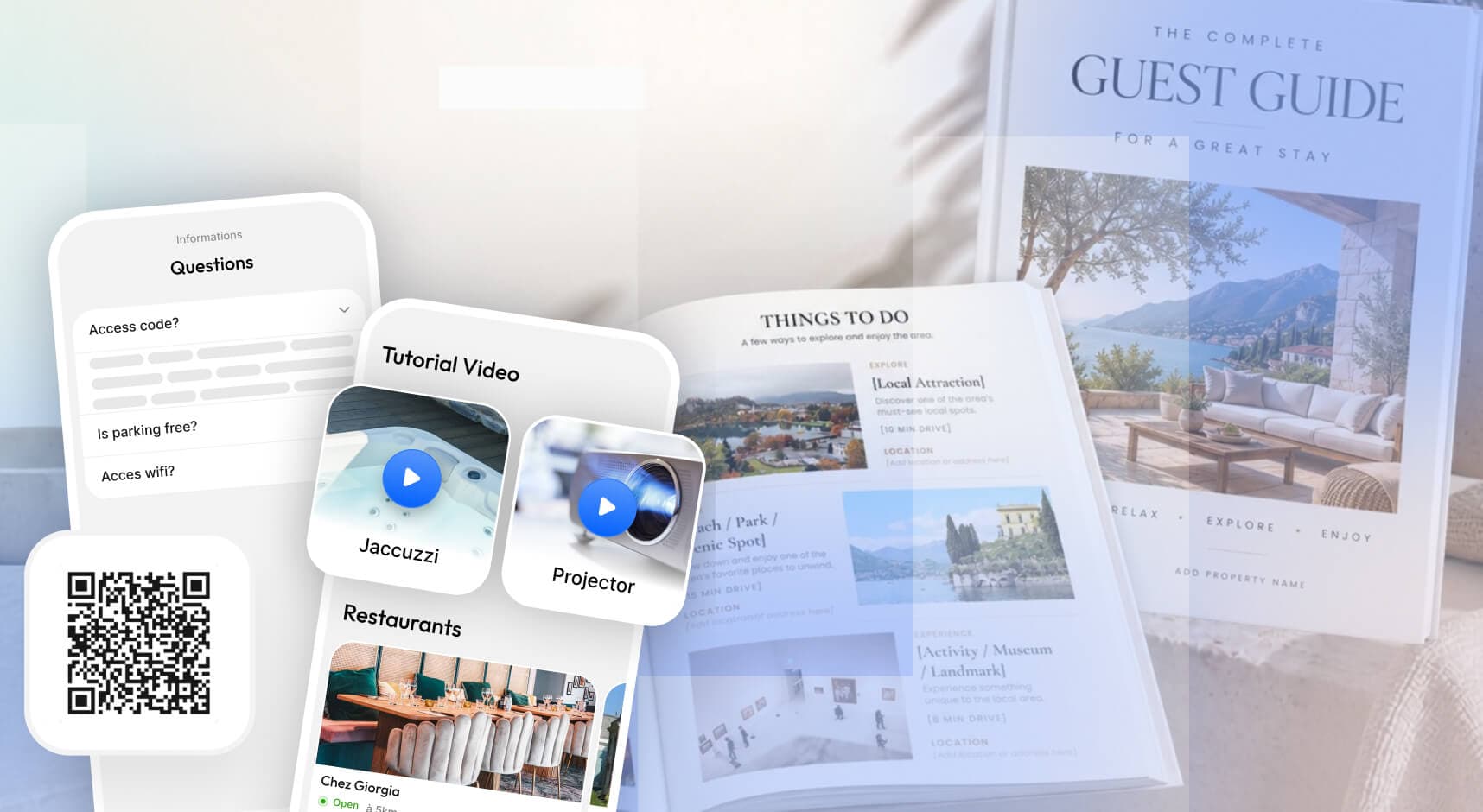
Airbnb welcome book templates on Etsy: what you actually receive
Most listings sit under ten dollars, and the writing is still yours. Which ones deliver a usable file, the five lines to read before you pay, and where a bought template stops paying for itself.